

Hands down, the most fascinating area of personal growth and development to me is identity work.
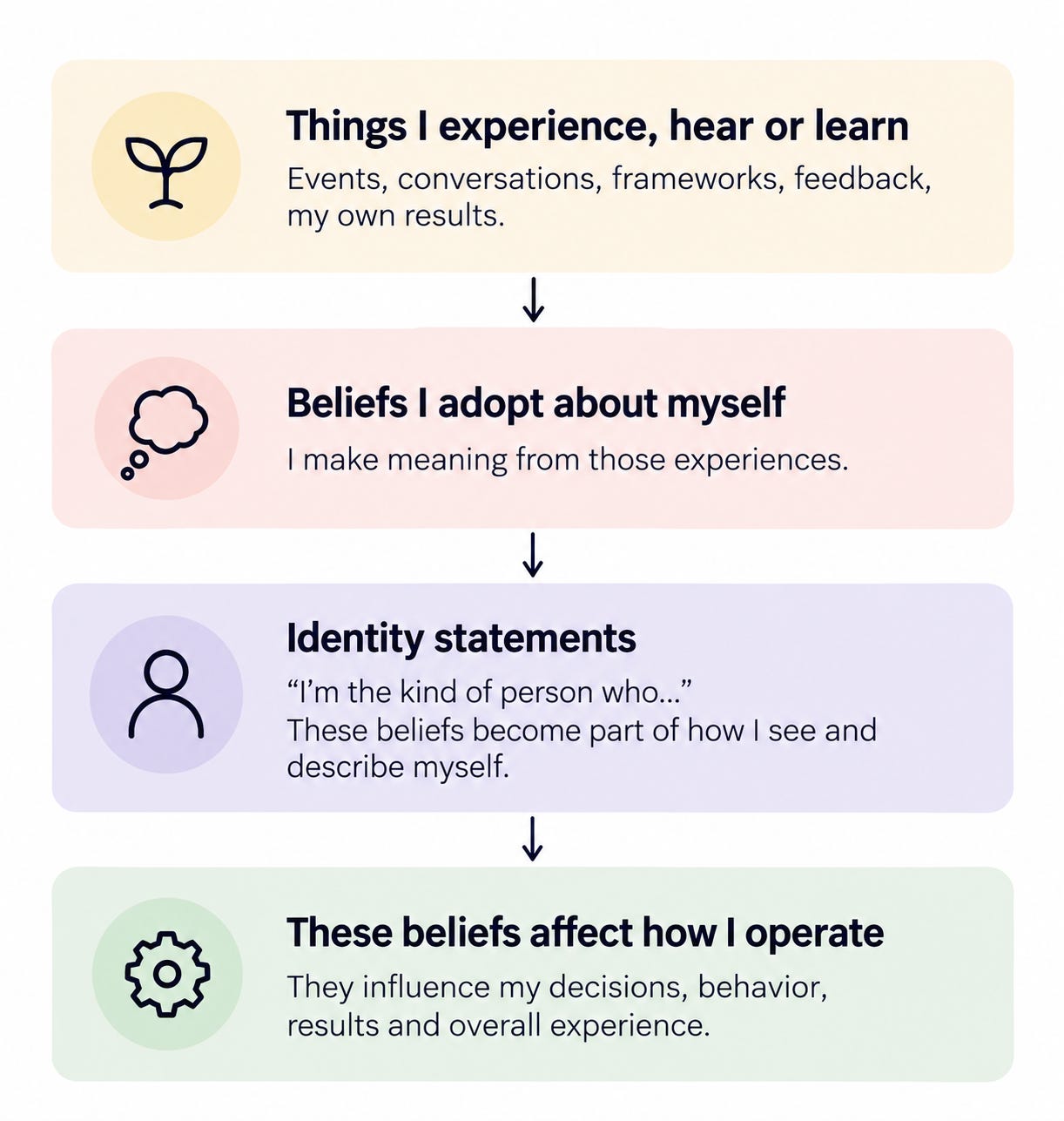
→ Identity is the collection of beliefs you hold about who you are and what kind of person you are.
→ Identity work is looking at those beliefs, understanding how they affect the way you operate, and then deciding what you want to keep and what you want to shift.
And while it’s common to talk about identity as one big self-image, I find it much more useful to look at the different beliefs that make up the overarching self-image.
You can see this in almost any system people use to understand themselves: astrology, Human Design, the Enneagram, personality profiles, strengths assessments.
Part of why people love these tools so much is that they give us language for identities we recognize in ourselves.
Whether any particular framework is valid is kind of beside the point. I’m interested in what happens when we come across a description, recognize ourselves in it and start using it as part of how we describe who we are.
For example, I’m a Libra. Libras are known for appreciating beauty. I love that.
Beauty is genuinely one of my values, and “I’m someone who notices and creates beauty” is an identity statement I’m very happy to claim.
Because I’ve claimed that identity, I can see how it affects the way I operate.
If I’m making lunch for myself, I’ll arrange it nicely on the plate. I’ll spend extra time making a room or a meal (or a document 🤓) look beautiful because, to me, it’s worth the effort.
But I’m sure there are plenty of Libra traits I don’t even know about and haven’t taken on.
We notice some descriptions, reject others, and absorb some so thoroughly that they feel like facts about who we are.
I am…
I’m not…
I’m the kind of person who…
I’m someone who always…
I’m someone who never…
That’s just not me.
Some of those identities may have come from a framework.
Some came from things other people repeatedly told us.
Some came from our own experience.
Over time, that collection of statements becomes part of our larger self-image.
And this is happening all the time, whether we’re paying attention or not.
Identity work is paying attention and consciously choosing which statements we want to keep reinforcing as part of how we understand ourselves.
A quick disclaimer: I’m not a psychologist, therapist or mental health professional. I’m sharing the way I personally think about and use identity work in business. This review is a self-reflection tool, not a psychological assessment, diagnosis or substitute for professional advice.
Where identity work misses the mark
A lot of the identity work I come across starts in the future.
Who do you want to become?
What would the next version of you do?
How would your future self handle this?
From there, the work is often to imagine the version of you who already operates that way.
She makes decisions confidently, has excellent boundaries, never misses a workout and fuels her body with organic kale from the best farms…
(Or something like that 😅)
And I can do that.
I can come up with a collection of statements that would feel really good if they were true.
But then what?
The advice is often to start acting like her now.
But, like, HOW?
If I already knew how to consistently make decisions, respond and operate like that version of me, I probably wouldn’t need identity work in the first place.
And describing her doesn’t tell me much about the identity I’m operating from today.
It doesn’t tell me what I currently believe about myself, how those beliefs are affecting the way I operate, which parts are serving me, or what I would need to practice differently for a new identity to become second nature.
It gives me a description of where I want to go, but I still need a way to understand where I’m starting and what would have to change between here and there.
So what does this look like in business?
While I could talk about the nuances of identity all day, let’s make this immediately useful for you and your business.
We each have a business owner identity: a collection of beliefs we hold about ourselves as a business owner, entrepreneur or service provider.
I’m the kind of person who always figures it out.
I’m not a salesperson.
I’m someone who takes care of my clients.
I’m the only person who can do this properly.
We have dozens of these identity statements that can affect how we make decisions, price our work, spend money, promote ourselves, follow up with leads, serve clients, build systems and delegate to other people.
Of course, identity is only one thing that affects how we operate.
Skills, circumstances, resources, habits and the situation itself matter too. But, identity can still play a big role.
Identity work in business asks the question:
What identities am I operating from in my business, and how are they affecting my experience and results?
Some of them may be exactly the identities I want to keep.
Others may have been useful once, but no longer fit the way I want to run my business now.
And some may be so normal to me that I’ve never thought to question them at all.
The parts of your business owner identity
Your business owner identity isn’t one single identity statement.
It’s made up of lots of smaller beliefs about who you are and how you operate in different parts of the business.
You might think of yourself as decisive when it comes to strategy, cautious when it comes to money, confident in delivery, uncomfortable with promotion, generous with clients and particular about delegation.
All of those beliefs can be part of the same business owner identity.
That’s why asking Who am I as a business owner? is too broad.
I find it more helpful to break that identity into the parts of business where different beliefs are likely to show up:
Decision-making — how you decide, commit, change course and stop
Creation — how you make things, improve them and decide when they’re done
Money — how you price, charge, spend, invest and allocate
Visibility — how you feel about being seen, sharing opinions and promoting your work
Sales — how you ask, follow up, handle hesitation and close the loop
Delivery — how you serve clients, maintain standards and manage boundaries
Operations — how you build and maintain the systems in the business
Delegation — how you hand over work, communicate standards and let someone else own it
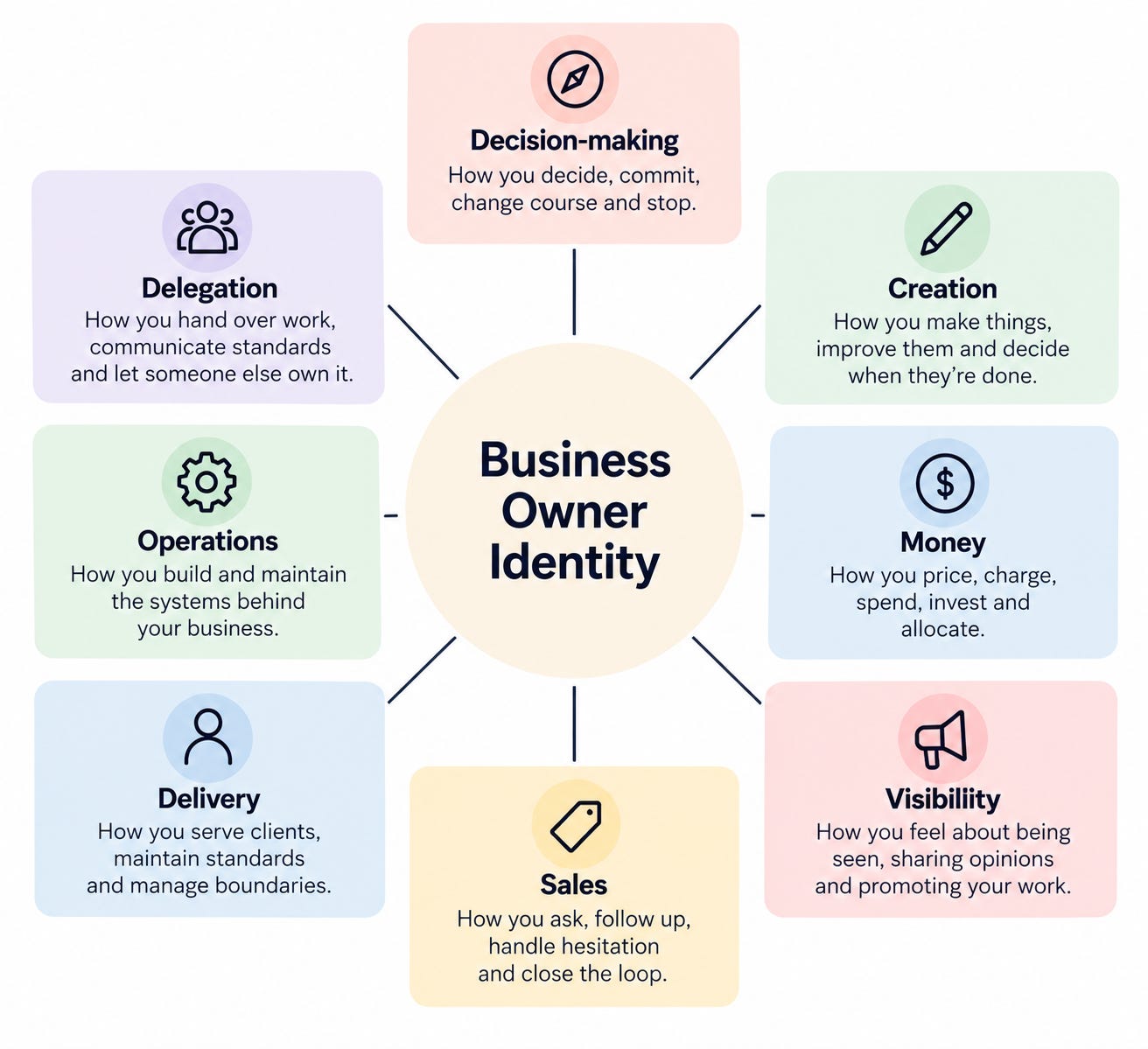
Looking at those parts separately gives you a much clearer view of your business owner identity as a whole.
You can start to see where your identity is already serving you, where you may be operating from a belief that no longer fits, and where you want to make a more deliberate choice about who you are in that part of the business.
Why your current identity is hard to see
If I ask you directly who you are as a business owner, your answer will usually reflect the self-image you already have.
If I ask:
Are you decisive?
Are you good with money?
Are you comfortable selling?
Are you good at delegating?
… you probably already have an answer.
And that answer may be completely accurate, but it may also only describe part of how you operate.
You might think of yourself as decisive because you make big decisions quickly, while spending weeks revisiting smaller decisions.
You might think of yourself as good at delegating because you hand work off easily, while regularly taking it back when it isn’t done the way you would do it.
You might say you’re comfortable selling because you have no problem making an offer, while rarely following up when someone doesn’t buy right away.
Those details give us a clearer picture.
They show us when an identity statement is true, which conditions affect it, and what other beliefs may also affect the way we operate.
We tend to describe ourselves using the identity statements we already know about.
But what about the identity statements and beliefs we don’t know about?
A single business scenario can’t tell us who we are. What becomes interesting is when similar choices keep showing up across different situations, especially when they add context to or conflict with how we already describe ourselves.
I wanted to figure this out.
So I built the Business Owner Identity Review
I built an AI-guided review around those eight parts of business.
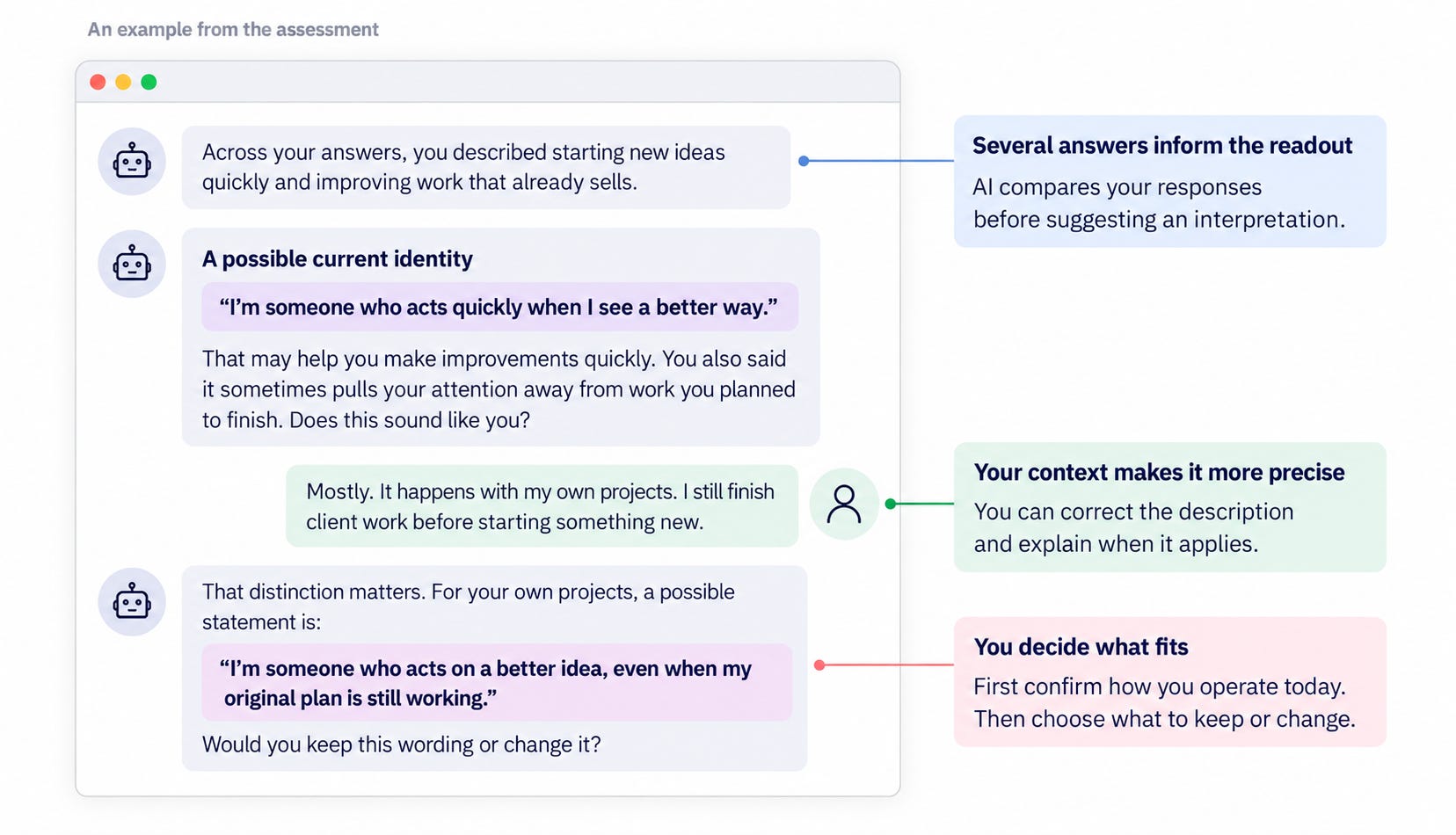
It gives you realistic business scenarios and asks how you would typically respond. Across multiple answers, AI can compare how you respond in different situations and suggest identity statements that may be affecting how you operate.
AI isn’t deciding who you are.
It is helping you compare your answers, notice things you may not have put into words before and suggest interpretations for you to consider.
You decide what feels accurate, add context where it matters, and choose what you want to keep, strengthen or change.
What it showed me
The review helped me put words to some ways I operate that I hadn’t clearly recognized before.
For example, I know I’m decisive. I make decisions quickly, trust my judgment and I’m comfortable changing course when I learn something new.
The review helped me notice something more specific: a new idea can sometimes start getting my time and attention before I’ve consciously decided it has become a priority.
The same thing happened in the Creation section.
I know I have high standards and I can ship quickly.
I also realized that because I see better versions of things very quickly, I can start rebuilding something or stop selling something 🤯 that is already working simply because I can see how much better it can be.
That led to an identity statement I want to reinforce:
I’m the kind of person who lets strong assets keep working while I improve them over time.
Choosing a new identity statement doesn’t mean pretending something is already true when it isn’t.
For me, it means deciding how I want to operate, then practicing that choice often enough that it becomes a more accurate description of who I am.
The review helped me see some of the ways I’m operating that are working for me and some of the things I want to shift to better align with my goals.
I turned the review into a downloadable Skill
A Skill is a set of instructions you install so your AI can guide you through a specific process.
I built the full process into a reusable Skill so you can run the Business Owner Identity Review for yourself in Claude or ChatGPT.
It uses the eight parts of your business owner identity to help you examine how you currently operate and gives you a personalized readout you can review, correct and use to choose the identity statements you want to reinforce going forward.
With this post, paid subscribers get:
the Business Owner Identity Skill
the complete Business Owner Identity Review
a personalized readout of your current business owner identity
prompts to help you decide what you want to keep, strengthen or change
a summary of the strongest themes that appear across different parts of your business
a finished
business-owner-identity.mdfile you can use as context for your AI
Your paid Hey Systems subscription also includes:
access to the Hey Systems Skool community
weekly check-ins
Q&A and support
the growing library of paid Hey Systems posts, Skills, tools and resources
By the end of the review, you’ll have a more specific understanding of your business owner identity today and a set of identity statements you’ve consciously chosen to keep or strengthen.
Allow about 30–45 minutes (or more if you want to go deeper, just tell it so). You’ll answer one question at a time, and you can pause whenever you need.
Paid subscribers can download the Skill and run the full review below.
ChatGPT note: Skill upload/install availability depends on your ChatGPT plan and workspace permissions. If you don’t see the Skills option, use the Claude version instead.