

Planning in business is such a racket, isn’t it?
You sit down for the planning session, set the goals, map out the plan and get really freaking excited to take big, bold action.
You’re ready. You know you can do it. This is IT.
Three months later, you realize you’ve barely looked at the plan.
Some of it happened anyway.
Some of it you completely forgot about.
And no less than 300 things changed in life and business making some of the plan redundant or obsolete.
This is the reality of planning in solo operator businesses.
And I really wouldn’t have a problem with it IF mapping the plan feels good and helps you feel organized and then you get to work.
BUT, here’s where I take massive issue:
When smart, capable, highly intelligent business owners make not following the plan mean something is wrong or bad about them.
You decide you’re undisciplined, or inconsistent, or bad at follow-through. You decide you just have to try harder or do more.
This is solving for entirely the wrong thing.
If a plant is not thriving in a particular environment, you change the environment. You don’t blame the plant.
What does it need to grow and thrive?
More light? Less water? A bigger pot?
You solve for what the plant really needs not for what it should need.
If you’ve created best-laid plans in your business and have a hard time following through, I promise you, you are not the problem… the plan is.
Planning is a tool, it’s a support. Its job is to make taking the right action easier.
If your plan is putting you in a box, feels like pressure or is creating too much resistance, it’s not the right plan.
The first principles of planning
These are the three principles I come back to before I build any plan.
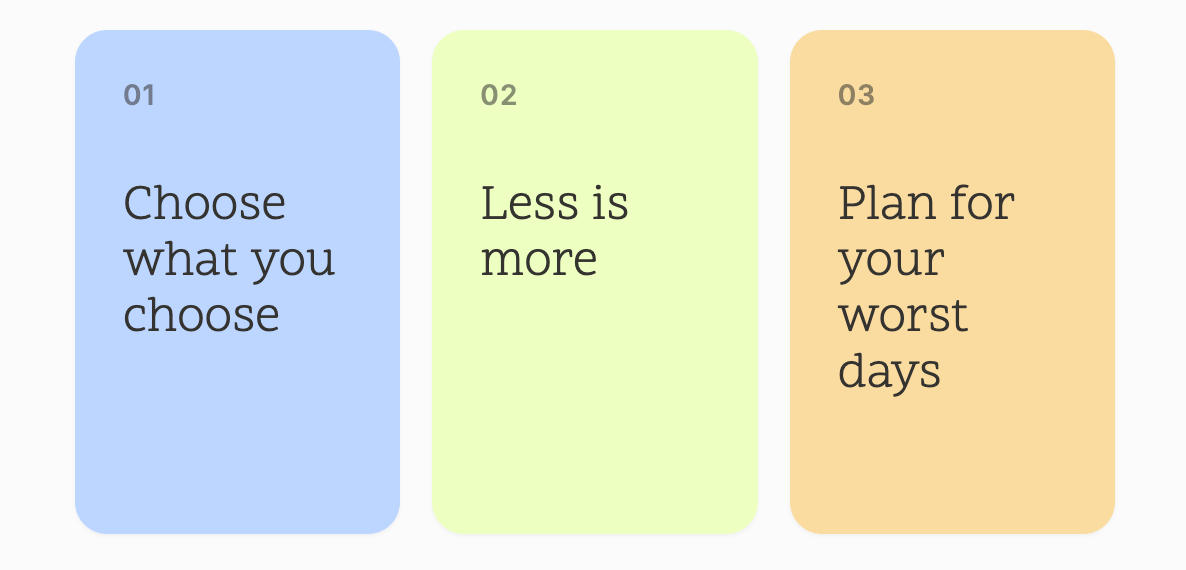
1. Choose what you choose
I know it sounds simple, but the power of deciding is highly underrated. When you decide, when you truly choose a direction, choose a goal, choose a strategy, choose an action plan, it changes the way you act.
If you make a plan that sounds good, but you haven’t really decided, then the first shiny object that comes along can sweep you away.
2. Less is more
One of the fastest ways I know to feel behind is to plan too much. The goal of a plan is to help you take the right action at the right time.
A plan should make it easier for you to sit down at your desk, get to work, and move forward on the things that matter most to you and your goals.
That means choosing fewer things to work on and getting them done instead of moving a lot of things forward a little bit.
3. Plan for your worst days
A plan that requires you to be operating at your best in order to be successful is a very painful way to operate day-to-day.
Of course we want to create the conditions to feel our best every day, but there are inevitable ups and downs in life, in energy, in circumstances.
It is much better to plan for those ups and downs than to expect that we operate at our best and beat ourselves up for “failing” when we don’t.
Why I plan in 90-day chunks
I’ve never once planned an entire year successfully.
Unless we have predictable cycles in our business, so much can change between now and eight months from now that makes proper planning impossible.
We can set our direction, goals, milestones, and map loose timelines but my experience as a solo operator has been that detailed planning for more than three months from now is a waste of time.
The lessons I learn from the strategies I implement now inform the strategies that I implement later.
In other words, I don’t know in Q2 where the best place is for me to focus my time and attention in Q4.
Ninety days is a different story. I know roughly what the next three months look like: what’s on the calendar, what my capacity is, and what’s coming up.
It’s long enough to make progress on something that matters and close enough that I can make plans with (some) confidence.
You get to simply ask:
What do you want to be true 90 days from now?
And then worry about what needs to happen after that, after that.
Before you plan a single thing
A lot of planning starts with the same question:
What do I want to accomplish?
And that can be helpful, especially if I’m in a season of life and business where I’m fired up, excited, and ready to rock.
But, I learned it’s much better for me to NOT start there.
Instead, I ask two questions:
What does my business need?
What do I need?
In solo operator businesses, these two things are inextricably linked, but we often don’t even consider what we might need.
I don’t know about you, but I’m here to play the long game. Sustainability has to be a factor in my decision-making.
Yes there are seasons of overworking but, if overworking is required 24-7 for my business to run, I don’t want it.
So before I choose a single goal, I open my calendar and look at what’s already there: trips, events, appointments, commitments, things I’m excited about, and things that will take time, energy, or attention.
Once I’ve looked at the calendar, I check in with my capacity.
How much energy do I have to put towards something new?
I then decide what “seasons” are best for me and my business in the next 90 days.
The four business seasons:
Building — focused time to create infrastructure: new offers, systems, workflows.
Maintaining — steady-state operations: delivering, supporting, admin, recurring tasks.
Growing — increasing visibility, scaling efforts, launching, momentum-building.
Resting — recovery after a sprint, a pause between chapters, or a low-capacity season.
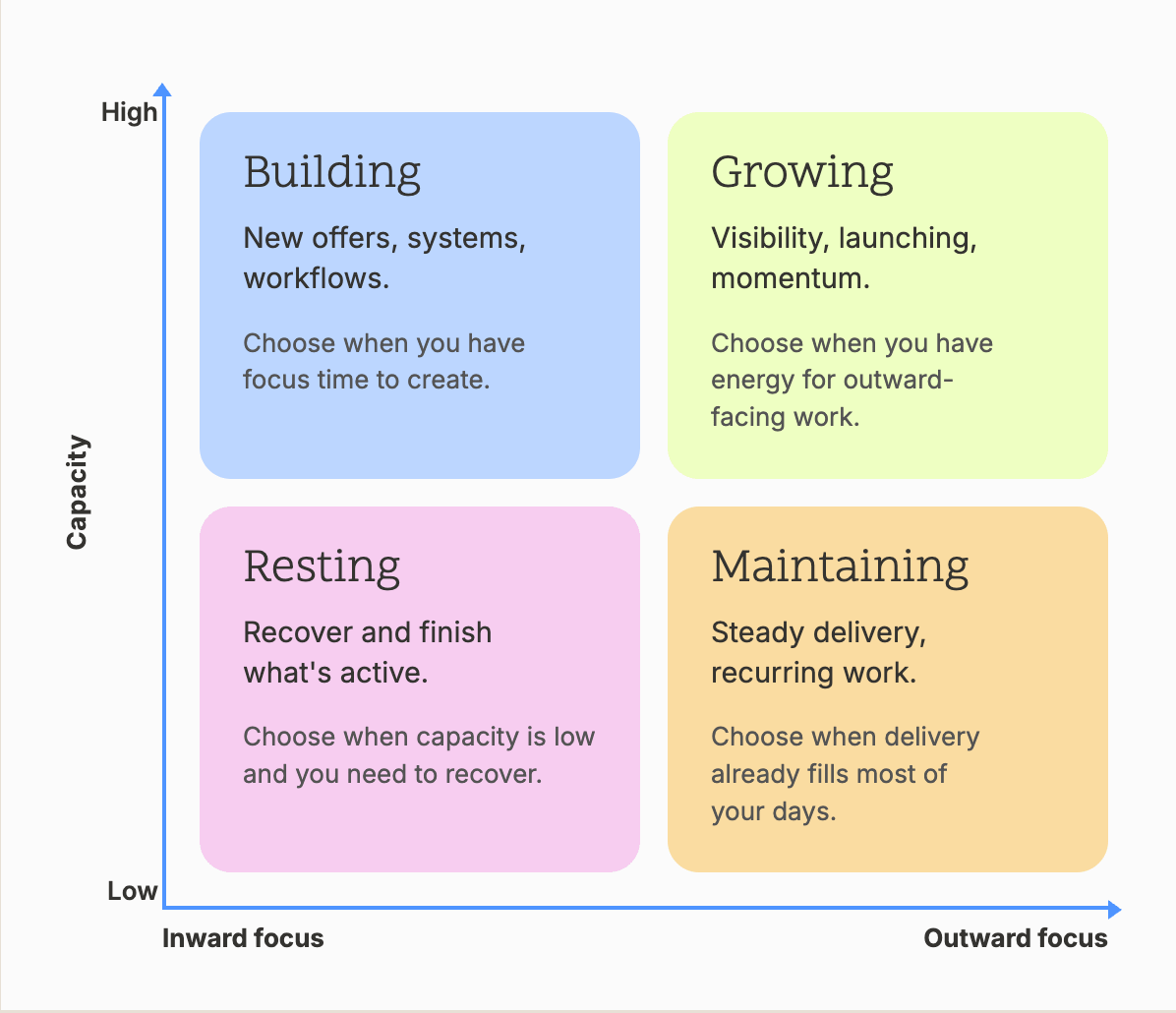
Choosing a season is really about making sure I take a step back and plan intentionally, rather than defaulting into old patterns of not checking my actual capacity or my life obligations.
So, it’s a quick check-in.
What season have I been in?
What season would support me now?
You don’t need one label for the whole quarter. You might spend a month focused on building and two months focused on growth.
Sometimes you need a whole 90 days in one season.
There are no rules, you get to make them up as you go.
BUT.. when you start planning from a place that takes your calendar and capacity into account alongside your goals and projects…
… you’ll be amazed at not only how much more you accomplish but how much more you enjoy the process.
The four levels of planning
I’ve been an Asana Certified Pro/ Asana Services Partner since they started the program. I’ve helped over 1,000 people manage their task list through my courses, programs, and client work.
And this is a concept I’ve repeated no less than 100 times.
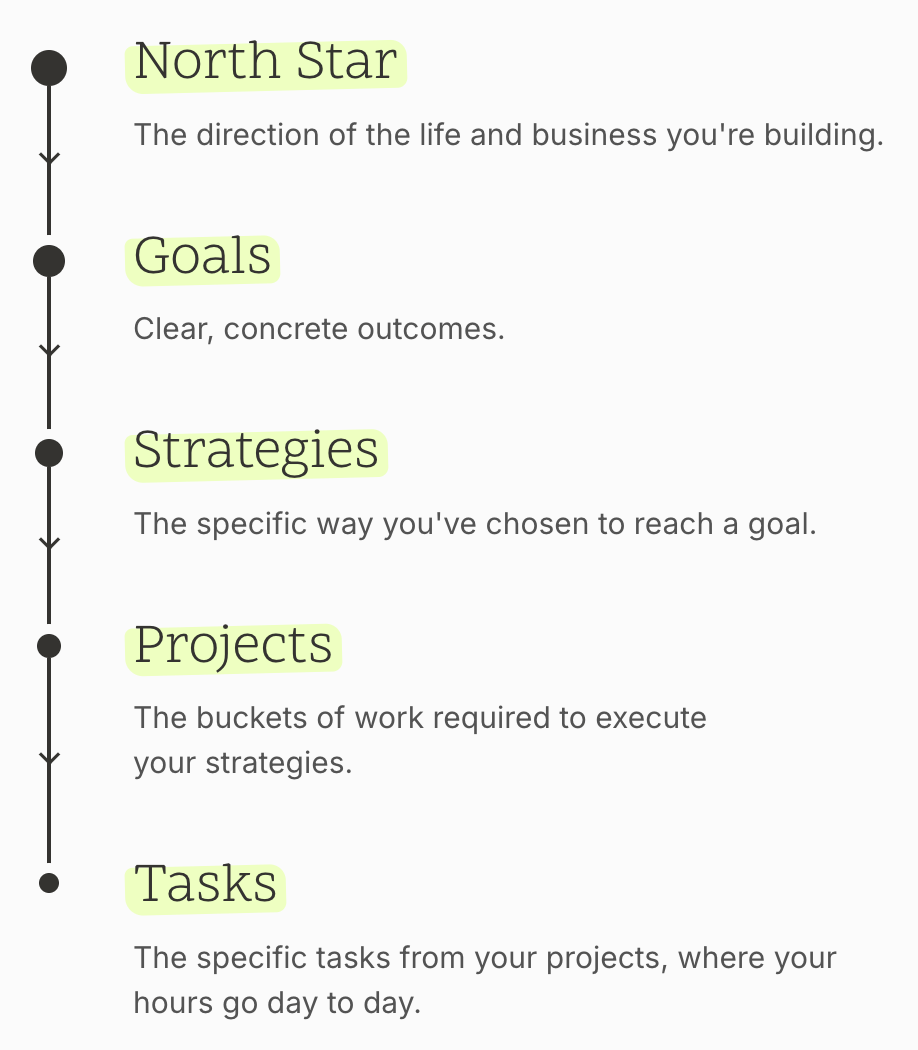
The quality of your planning dictates how your day-to-day feels.
Tasks are downstream from projects…
That are downstream from strategies…
That are downstream from goals…
That are downstream from your North Star.
They are connected.
What I see over and over again is ideas getting immediately turned into to-dos without being vetted through the lens of goals and strategies.
You might see a post about how someone is crushing it on Pinterest and then pop “create a Pinterest account” on your to-do list.
Now this becomes a thing you “need” to do that makes you feel behind every day that you don’t get it done. It’s madness.
Think of your planning process like a club bouncer. Its job is to vet each idea, strategy, project and make sure that it belongs there.
Your task list is more than a collection of everything you need to do.
Your task list is a collection of the things you’ve decided are important enough to spend the precious moments of your life on.
I know it’s a little dramatic, but I love seeing people be more discerning, more exclusive, and more snobby about what gets to take up space on their task list.
If planning has never worked for you
If you find yourself making the same goals, the same plans, on repeat and losing track a couple of weeks into each quarter… Girl, same.
I honestly thought something was fundamentally wrong with me.
I love my work. I care so much. I work really hard. I couldn’t understand why I couldn’t just stick to a freaking plan.
But it turns out, starting with goals and rushing straight to a long list of tasks didn’t work for me.
I needed a plan that was clear and flexible, that kept the most important things front and center, and made it easy for me to keep moving towards my North Star.
This process does that.
Your quarterly planning process
Now we’re going to build your plan.
We’ll go through each step:
Look at your quarter — calendar, capacity, season
Reconnect or identify your North Star
Choose your 1–3 goals
Pick your strategies and projects
Identify your milestones
Set the level of task detail that works for you
If you aren’t ready to do your planning right now then block an hour in your calendar and set aside some time in a vibey corner of your house or a cafe in the next few days.
If you are ready, we’re about to go through it step-by-step.
You can do this with a pen and paper as you read.
Or, if you want the guided version, you can install the Quarterly Planning Skill and let it walk you through the same process step by step. 😎